How to Read Pantry Package Storage Symbols and Labels
A pantry package label review helps you interpret storage symbols, choose a suitable spot, and keep useful product details accessible without reorganizing the kitchen.
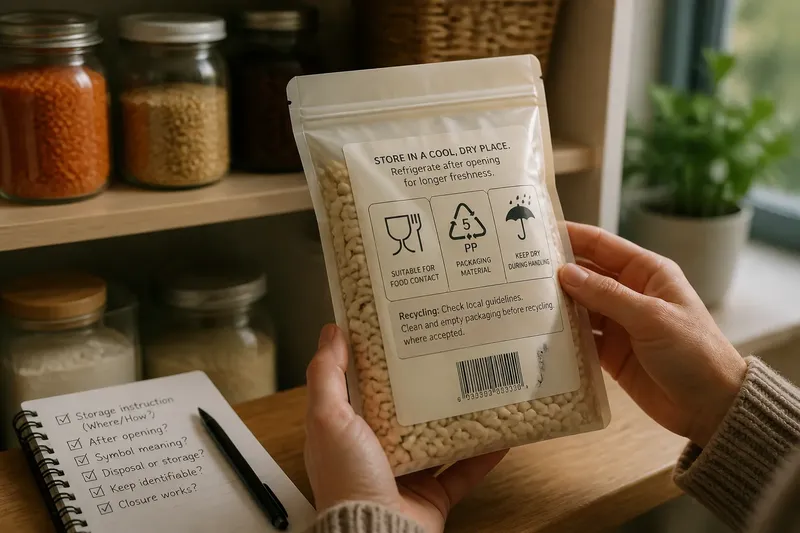
A pantry package label review works best when you focus on the symbols and wording that affect where a product belongs. A small cup-and-fork icon, a recycling mark, and a storage instruction answer different questions; treating them as interchangeable can send you searching for guidance that is not there.
Start with the label’s purpose. Storage text describes conditions for the food, packaging symbols may describe handling or disposal, and product identity information helps you recognize what is inside. Keep those jobs separate, and you can make a clear decision without turning a shelf into a paperwork project.
Separate label messages
Look for direct storage wording such as “store in a cool, dry place” or “refrigerate after opening.” Those phrases tell you how to place or handle the product. A recycling symbol, by contrast, concerns the package material or disposal instructions; it does not tell you where to keep the food.
Some marks describe packaging suitability or handling rather than storage. A cup-and-fork symbol is commonly used to indicate food-contact suitability, while a “keep dry” symbol may communicate a packaging-handling condition. If a mark is unfamiliar or unclear, check the manufacturer’s explanation rather than guessing from its shape.
Read symbols in context
Symbols can vary by market, material, and package design, so read nearby wording too. A recycling triangle may identify a material, but local collection rules determine whether that material belongs in a curbside bin. A symbol alone may not tell you how to prepare the package for recycling.
For an opened product, give priority to explicit after-opening wording. Do not infer that a recycling mark or food-contact symbol is a storage instruction. If the label gives no clear answer about a storage question that matters, consult the product maker or appropriate local food-safety guidance.
Make a label decision
- Check for an explicit storage phrase; if it names a condition or location, follow it, and if it is absent, do not invent a special instruction.
- Check whether the wording applies only after opening; if it does, plan for that change, and if it does not, use the stated direction for the package’s current state.
- Check whether a symbol is accompanied by explanatory text; if the meaning is clear, use it for that purpose, and if not, verify with the manufacturer instead of guessing.
- Check whether a mark concerns disposal rather than food storage; if it is a recycling or material code, consult local recycling guidance, and if it is a storage statement, follow its wording.
- Check whether the package itself remains identifiable; if its label will be lost during transfer, keep the original information accessible, and if it remains attached and readable, retain it with the package.
- Check whether a closure works as intended; if it closes securely, use it as directed, and if it does not, choose a clean suitable container when appropriate while preserving relevant label details.
What do common symbols mean?
Does a recycling triangle mean the package is recyclable?
Not necessarily. It may identify the package material, while acceptance depends on local collection rules and the full packaging configuration. Check your local recycling guidance before deciding what to put in a bin.
Does a cup-and-fork symbol explain storage?
No. It is generally associated with suitability for food contact, not with pantry or refrigerator placement. Use explicit storage wording for that decision.
What does “keep dry” tell me?
Read the full label to see whether the instruction applies to the packaging during handling or to the food during storage. If the wording is ambiguous, ask the manufacturer rather than assigning a meaning based only on the icon.
What should I do with an unfamiliar mark?
Check the text around it and look for the product maker’s explanation. If the symbol does not resolve a food-storage question, rely on clear product instructions or qualified local guidance instead of treating the mark as a substitute.
A worked label review
Imagine you bring home a hypothetical bag of dried beans. The package has a recycling triangle, the words “store in a cool, dry place,” and a zipper closure. First, you treat the storage phrase as the instruction for the food; next, you treat the triangle as a packaging mark and check local disposal guidance separately; then you close the zipper and place the bag in a suitable dry cupboard. The resulting decision is clear: the beans have a storage location, the package stays identifiable, and the recycling question remains separate from food storage.
It is not worth decoding every decorative graphic or rearranging a pantry because a symbol looks important. Focus on readable instructions, confirm unfamiliar marks through a reliable source, and keep disposal decisions distinct from food-storage choices. A careful pantry package label review can be brief while still answering the question that brought you to the label.