Why Ingredients Appear in a Particular Order
Why ingredients appear in a particular order reveals which components rank highest by weight, helping you compare similar foods without mistaking rank for a recipe.
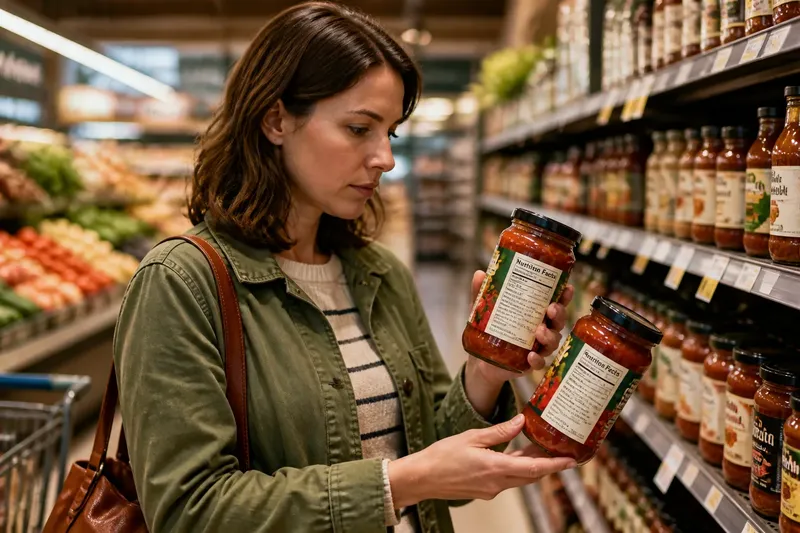
Two jars of salsa can both feature tomatoes on the front, yet their ingredient lists may tell different stories. Why ingredients appear in a particular order comes down to weight: ingredients are generally listed from most to least by the amount used in the food.
That makes the sequence useful for comparing a product’s composition, but it is not a recipe with exact amounts. Read the order as a ranking, then decide whether the difference matters for the choice in front of you.
Read the leading ingredients
The first entries give you a quick sense of what forms the product’s base. In plain peanut butter, peanuts near the beginning signal that they are a prominent component; in a different spread, sugar or oil appearing earlier would be a meaningful point of comparison.
Keep reading beyond the first ingredient. Water, oils, grains, vegetables, flavorings, and other components can all help explain how two products differ. The sequence does not reveal exact proportions, so resist turning it into a guessed recipe.
Compare similar foods
Ingredient order is most helpful when the products serve the same purpose. Compare two tomato sauces, two loaves of bread, or two jars of nut butter—not a concentrated paste against a ready-to-serve sauce, whose ingredients may rank differently because the products are made for different uses.
Say you are choosing between two jars of tomato sauce for pasta. Jar A lists tomatoes, water, and onion; Jar B lists water, tomatoes, and onion. Those invented lists suggest that tomatoes rank ahead of water in Jar A and behind it in Jar B, but they do not tell you the exact amount of either. Your practical conclusion is limited: if a tomato-forward composition is your priority, Jar A merits a closer look; if not, the ranking alone does not settle the choice.
Check the full list
Order matters less than presence when you are looking for a particular ingredient. Scan every entry, including details in parentheses after a compound ingredient such as a seasoning blend or chocolate. A term near the end is still present.
If you avoid an ingredient for a preference, decide what names you need to check before shopping. For an allergy or other medical concern, do not judge safety by an ingredient’s position; follow the product’s applicable allergen information and guidance from a qualified health professional. Label rules and wording can vary by location.
Read grouped components
A label may name a broader component and then list its sub-ingredients in parentheses. Treat those details as part of the ingredient list, not as an optional footnote. They can help you spot a specific component that a quick scan of the main entries would miss.
Some ingredients may also appear under permitted category names, and labeling rules can affect how certain components are presented. If the precise identity matters to your decision, check the complete label or ask the manufacturer rather than inferring an exact quantity from the wording.
What does order tell you?
Does the first ingredient make up most of the food?
Not necessarily. It generally ranks highest by weight among the ingredients under the applicable labeling rules, but its position does not show that it makes up more than half the product.
Can I estimate exact amounts from the list?
No. The sequence gives relative placement, not a complete breakdown. It can show that one ingredient ranks ahead of another, but not the precise share of either.
Should I ignore ingredients near the end?
No, especially if you are checking for a particular ingredient. A lower position indicates a lower relative rank, not absence; read the full list when presence matters.
Does a shorter list mean a better food?
Not by itself. A short list may suit a simple product, while a prepared food may need several components for its intended texture, flavor, or preservation. Judge the list against your specific question rather than treating length as a quality score.
Make a useful comparison
- Observation: A product’s first listed ingredient is the one ranked highest by weight. If you want to know its main component, then start there; otherwise, compare the entries relevant to your actual choice.
- Observation: A shared ingredient appears earlier on one of two similar products. If prominence matters to you, then investigate that product further; otherwise, do not treat rank alone as a reason to switch.
- Observation: The products serve different purposes, such as paste and ready-to-serve sauce. If their formats differ, then compare products with the same use; otherwise, the rank difference may not answer your question.
- Observation: A name in parentheses contains a component you are checking for. If that component matters, then count it as present and choose another product if needed; otherwise, continue reading for other relevant details.
- Observation: An ingredient you avoid appears near the end. If presence is the issue, then do not dismiss it because of its rank; otherwise, use the sequence only as a composition clue.
- Observation: You are trying to determine exact proportions from the order. If exact amounts are essential, then seek product information that states them; otherwise, use the list only to compare relative ranking.
It is not worth the effort to reconstruct a product’s exact recipe from its ranked list. The useful question is smaller: which ingredients appear most prominent, and does that help you choose between comparable foods? Why ingredients appear in a particular order is a practical clue to composition—not a verdict on the whole product.